


Welcome to the sixth issue of The Weekly Landing.
If you’re joining us for the first time, welcome. Each week we’ll spend time exploring timeless wisdom from Scripture, Christian theology, history, philosophy, and the great works that have shaped Christian civilization and the American story.
The goal is simple: to help people think deeply, live faithfully, and preserve the inheritance of biblical truth for the next generation.
Let’s begin.
✝️ Scripture This Week
Isaiah 46:10
10 I make known the end from the beginning, from ancient times, what is still to come. I say, ‘My purpose will stand, and I will do all that I please.’
Proverbs 16:9
9 In their hearts humans plan their course, but the Lord establishes their steps.
Esther 4:1, 4-17
1 When Mordecai learned of all that had been done, he tore his clothes, put on sackcloth and ashes, and went out into the city, wailing loudly and bitterly.
4 When Esther’s eunuchs and female attendants came and told her about Mordecai, she was in great distress. She sent clothes for him to put on instead of his sackcloth, but he would not accept them. 5 Then Esther summoned Hathak, one of the king’s eunuchs assigned to attend her, and ordered him to find out what was troubling Mordecai and why.
6 So Hathak went out to Mordecai in the open square of the city in front of the king’s gate. 7 Mordecai told him everything that had happened to him, including the exact amount of money Haman had promised to pay into the royal treasury for the destruction of the Jews. 8 He also gave him a copy of the text of the edict for their annihilation, which had been published in Susa, to show to Esther and explain it to her, and he told him to instruct her to go into the king’s presence to beg for mercy and plead with him for her people.
9 Hathak went back and reported to Esther what Mordecai had said. 10 Then she instructed him to say to Mordecai, 11 “All the king’s officials and the people of the royal provinces know that for any man or woman who approaches the king in the inner court without being summoned the king has but one law: that they be put to death unless the king extends the gold scepter to them and spares their lives. But thirty days have passed since I was called to go to the king.”
12 When Esther’s words were reported to Mordecai, 13 he sent back this answer: “Do not think that because you are in the king’s house you alone of all the Jews will escape. 14 For if you remain silent at this time, relief and deliverance for the Jews will arise from another place, but you and your father’s family will perish. And who knows but that you have come to your royal position for such a time as this?”
15 Then Esther sent this reply to Mordecai: 16 “Go, gather together all the Jews who are in Susa, and fast for me. Do not eat or drink for three days, night or day. I and my attendants will fast as you do. When this is done, I will go to the king, even though it is against the law. And if I perish, I perish.”
17 So Mordecai went away and carried out all of Esther’s instructions. 1
📜 Historical Anecdote This Week
The Furnace of Affliction
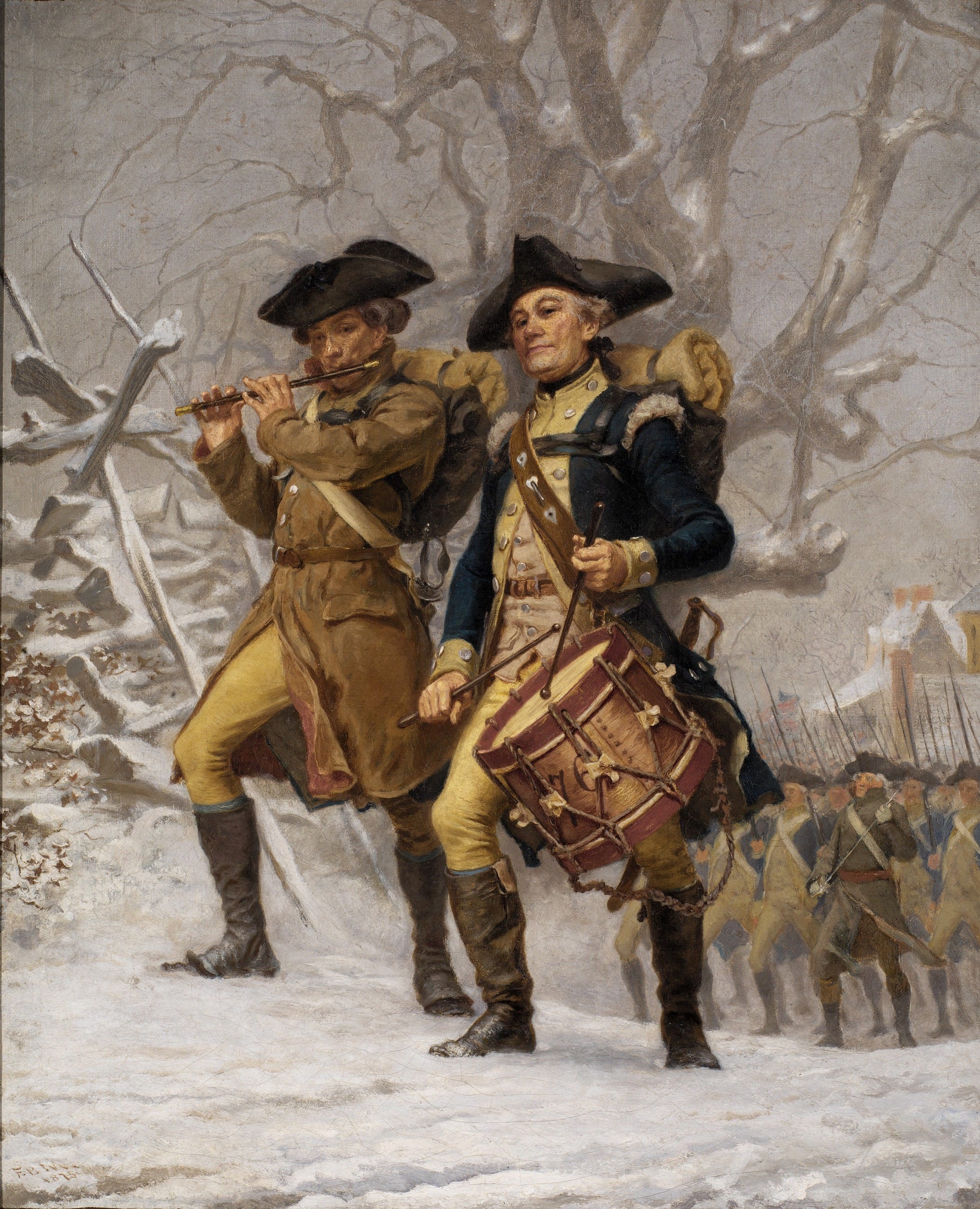
In 1776, American patriots faced a decision that could cost them everything. Choosing independence meant risking their lives, homes, livelihoods, property, and families. If the Revolution failed, those who openly resisted British authority could face imprisonment, execution, or the loss of everything they possessed.
Thomas Jefferson later reflected on what might have happened if Americans had allowed fear to govern them. He asked what would have become of the country “if our country, when pressed with wrongs at the point of the bayonet, had been governed by its heads instead of its hearts.” His answer was chilling: “where should we have been now? hanging on a gallows as high as Haman’s.” 2
Yet thousands of Americans continued to serve, fight, provide supplies, endure hardship, and support the cause of independence. They did not know whether the Revolution would succeed. They knew only that they believed liberty was worth the sacrifice, and like Queen Esther, they took the risk even if it meant their lives.
John Adams understood that such trials could shape the character of a people. He wrote, “The Furnace of Affliction produces Refinement, in States as well as Individuals.” He believed that the hardships of the Revolution could purify the nation’s vices and strengthen its virtues—but only if Americans allowed suffering to make them better rather than bitter.
Adams ultimately recognized that the future was beyond human control. He therefore submitted his “Hopes and Fears, to an overruling Providence, in which, unfashionable as the Faith may be, I firmly believe.” 3
The American patriots could not see how their story would end. They could only choose how they would live through the trial.
Their example reminds us that the furnace of affliction can reveal character, refine virtue, and teach a people to place its hopes not merely in itself, but in the providence of God.
🏛️ Wisdom Through the Ages
Excerpt from Matthew Henry and His Bible Commentary
Reflecting on the Book of Esther, Rev. Henry discussed Mordecai and Esther’s messages they exchanged, with Mordecai arguing a providential plan taking place. He says…
“That divine Providence had an eye to this in bringing her to be queen: "Who knows whether thou hast come to the kingdom for such a time as this?”…..Now, [1.] It appeared, by the event, that she did come to the kingdom that she might be an instrument of the Jews’ deliverance, so that Mordecai was right in the conjecture. Because the Lord loved his people, therefore he made Esther queen. There is a wise counsel and design in all the providences of God, which is unknown to us till it is accomplished, but it will prove, in the issue, that they are all intended for, and centre in, the good of the church.” 5
Rev. Henry’s words of wisdom can be sum up into what Dr. David Martin said, “God doesn’t just call people, he positions them.” 6
💭 One Thought to Ponder
“We should every one of us consider for what end God has put us in the place where we are, and study to answer that end; and, when any particular opportunity of serving God and our generation offers itself, we must take care that we do not let it slip; for we were entrusted with it that we might improve it.”
— Matthew Henry (from his Commentary on the Whole Bible (1706), specifically commenting on Esther 4:5-17) 7
❓Questions to Consider
Are you doing things from a place of humility and faith, or from a place of pride and fear?
Where do you need to realign yourself with God’s purpose for your life through prayer, and then through willing obedience to that end?
Thank you for reading Volume 2026 | Issue No. 6 of The Weekly Landing.
If this issue was meaningful to you, consider subscribing and sharing it with others who may benefit from reflections on Scripture, theology, history, philosophy, and the enduring ideas that have shaped Christian civilization and the American Story.
New issues are published every Wednesday.
About The Weekly Landing
The Weekly Landing is the flagship publication of History Landing 1620, exploring Scripture, history, philosophy, and the ideas that have shaped Christian civilization and the American Story.
While The Weekly Landing’s regular Wednesday newsletter will always remain free, this publication may also include additional essays, book recommendations, historical resources, and other special features published throughout the year. These pieces are part of the broader work of History Landing 1620 and its mission to encourage thoughtful reading, historical understanding, faithful living, and lifelong learning.
Through The Weekly Landing, History Landing 1620 seeks to recover the wisdom of the past and apply it faithfully to the present—preserving the lessons, ideas, books, and principles worth passing on to the next generation.
Timeless Wisdom. Faithful Living. A Legacy Worth Leaving.
Recovering the Christian Roots of America.
Published by History Landing 1620
Sources & Citations
1. Scripture
Scripture quotations are from the Holy Bible, New International Version® (NIV®). Copyright © 1973, 1978, 1984, 2011 by Biblica, Inc.® Used by permission. All rights reserved worldwide.
2. Historical Quotation (Jefferson)
Thomas Jefferson to Maria Cosway, October 12, 1786. The Papers of Thomas Jefferson, vol. 10, 22 June–31 December 1786, ed. Julian P. Boyd. Princeton: Princeton University Press, 1954, pp. 443–455. Founders Online, National Archives. https://founders.archives.gov/documents/Jefferson/01-10-02-0309
3. Historical Quotation (Adams)
John Adams to Abigail Adams, July 3, 1776. The Adams Papers, Adams Family Correspondence, vol. 2, June 1776–March 1778, ed. L. H. Butterfield. Cambridge, MA: Harvard University Press, 1963, pp. 27–29. Founders Online, National Archives.
https://founders.archives.gov/documents/Adams/04-02-02-0015
4. Image
5. Wisdom Through the Ages (Citation #1)
Matthew Henry, Matthew Henry’s Commentary on the Whole Bible. Accessed via Bible Hub. https://biblehub.com/commentaries/mhcw/esther/4.htm
6. Wisdom Through the Ages (Citation #2)
Dr. David Martin, “God doesn’t just call people, he positions them,” Instagram post, Instagram, accessed August 2, 2026. Instagram — Dr. David Martin
7. Quote
Matthew Henry, Matthew Henry’s Commentary on the Whole Bible. Accessed via Bible Hub. https://biblehub.com/commentaries/mhcw/esther/4.htm
© 2026 Tyler Anthony Loiselle. Published by History Landing 1620. All Rights Reserved.