


Welcome to the seventh issue of The Weekly Landing.
If you’re joining us for the first time, welcome. Each week we’ll spend time exploring timeless wisdom from Scripture, Christian theology, history, philosophy, and the great works that have shaped Christian civilization and the American story.
The goal is simple: to help people think deeply, live faithfully, and preserve the inheritance of biblical truth for the next generation.
Let’s begin.
✝️ Scripture This Week
Titus 3:1
1 Remind the people to be subject to rulers and authorities, to be obedient, to be ready to do whatever is good,
1 Timothy 2:1-3
1 I urge, then, first of all, that petitions, prayers, intercession and thanksgiving be made for all people— 2 for kings and all those in authority, that we may live peaceful and quiet lives in all godliness and holiness. 3 This is good, and pleases God our Savior, (Emphasis added)
Romans 13:1-5
1 Let everyone be subject to the governing authorities, for there is no authority except that which God has established. The authorities that exist have been established by God. 2 Consequently, whoever rebels against the authority is rebelling against what God has instituted, and those who do so will bring judgment on themselves. 3 For rulers hold no terror for those who do right, but for those who do wrong. Do you want to be free from fear of the one in authority? Then do what is right and you will be commended. 4 For the one in authority is God’s servant for your good. But if you do wrong, be afraid, for rulers do not bear the sword for no reason. They are God’s servants, agents of wrath to bring punishment on the wrongdoer. 5 Therefore, it is necessary to submit to the authorities, not only because of possible punishment but also as a matter of conscience. 1
📜 Historical Anecdote This Week
A Framework for a Community
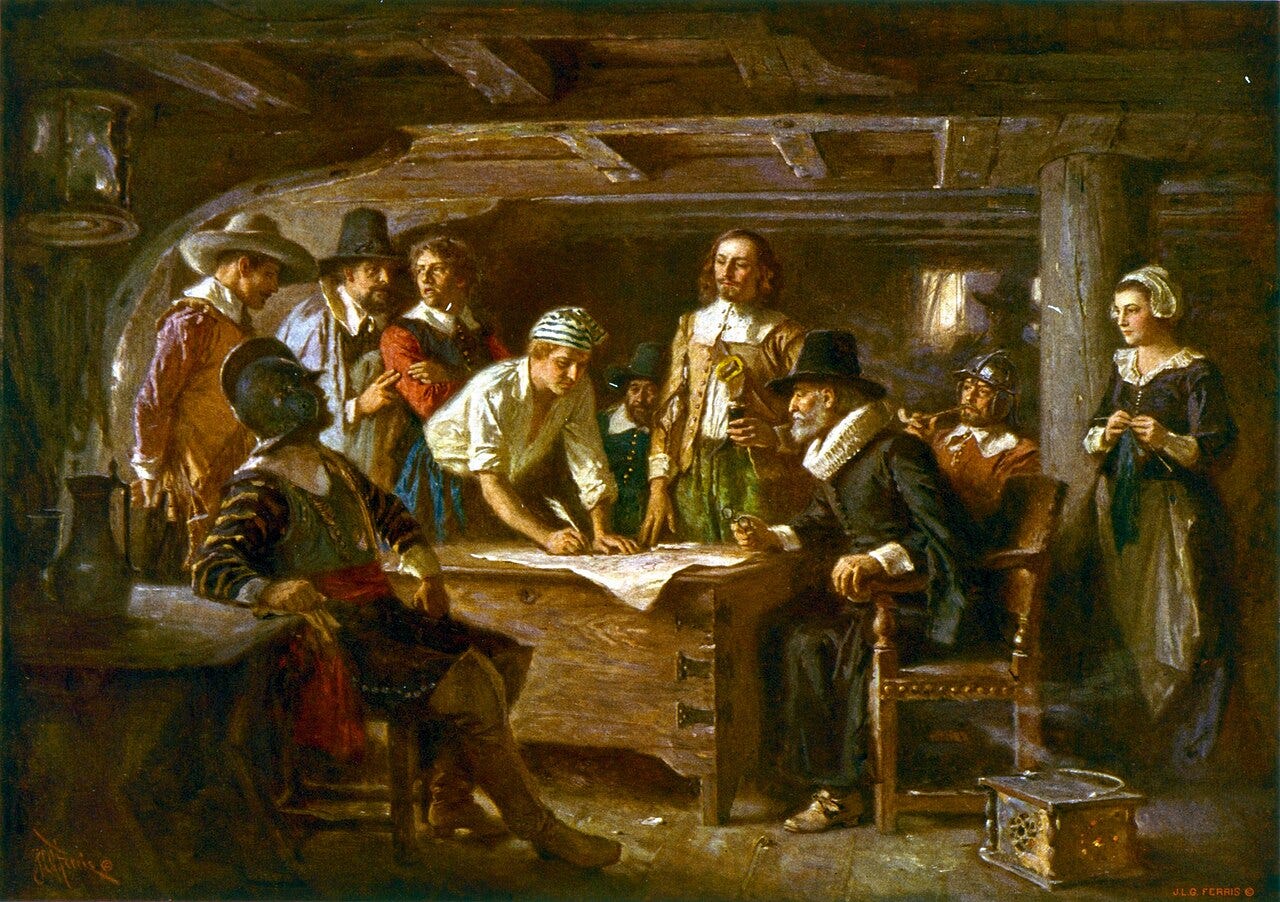
On November 11, 1620, before setting foot upon the shores of what would become New England, the Pilgrims and other passengers aboard the Mayflower recognized a problem that every community eventually faces: people living together need order, authority, and laws.
Their destination was Virginia, but circumstances had brought them far north of their intended settlement landing at the tip of Cape Cod in Massachusetts. Rather than allowing uncertainty and disagreement to fracture the company, forty-one of the adult male passengers agreed to establish a civil government for the sake of their common good.
The document they signed became known as the Mayflower Compact.
It was remarkably brief. Yet within its few sentences was a significant principle of self-government, creating the first document to establish self government in the New World. The signers first acknowledged their allegiance to “our dread Sovereign Lord King James” and then stated their purpose: to “covenant and combine ourselves together into a civil Body Politick.”
They agreed to enact such “just and equal Laws” as would be considered most suitable for the “general Good of the Colony,” promising “all due Submission and Obedience.” 2
The Compact did not declare that every individual could simply do whatever he pleased. Nor did it treat government as something inherently opposed to liberty. Instead, the signers recognized that ordered liberty required both legitimate authority and willing obedience to just laws.
Their words also reveal something important about the Christian understanding of civil society. The Pilgrims did not see their political community as existing merely for individual advantage. They bound themselves together for the common good, acknowledging that freedom requires responsibility and that a community cannot endure without a willingness among its members to submit to lawful authority.
The Mayflower Compact therefore presents a picture of government not as an end in itself, but as an instrument for maintaining order and pursuing the good of the community, ultimately recognizing the necessity of establishing government.
🏛️ Wisdom Through the Ages
Excerpt from the Federalist Papers
In Federalist No. 51, published in 1788 under the pseudonym “Publius,” James Madison observed that “if men were angels, no government would be necessary,” capturing the Founders’ understanding of human nature and the necessity of limiting the power of government itself. He states…
“Ambition must be made to counteract ambition. The interest of the man must be connected with the constitutional rights of the place. It may be a reflection on human nature, that such devices should be necessary to control the abuses of government. But what is government itself, but the greatest of all reflections on human nature? If men were angels, no government would be necessary. If angels were to govern men, neither external nor internal controls on government would be necessary. In framing a government which is to be administered by men over men, the great difficulty lies in this: you must first enable the government to control the governed; and in the next place oblige it to control itself.” 4
Together, the Pilgrims’ and Madison’s ideas point toward a central principle of ordered liberty: a free people need both the virtue to govern themselves and the wisdom to restrain those who govern them.
💭 One Thought to Ponder
Just remember that though the world’s authority may change from time to time, God’s authority does not, and His reign never ends - we have hope!
“Those that oppose God’s counsels may possibly prevail so far as to think they have gained their point, and yet be deceived…Note, There are many devices in man’s heart, many devices of the enemies of God’s people to destroy them and of their friends to help them, which perhaps are both disappointed, as these were; but the counsel of the Lord, that shall stand.”
— Matthew Henry (from his Commentary on the Whole Bible (1706), specifically commenting on Genesis 37:23-30 concerning Joseph's enslavement and God’s soverignty.) 5
❓Questions to Consider
What responsibility has God given you in the community, government, or sphere of influence where He has placed you?
How can you more faithfully steward that responsibility through prayer, obedience, service, and wise participation?
Thank you for reading Volume 2026 | Issue No. 7 of The Weekly Landing.
If this issue was meaningful to you, consider subscribing and sharing it with others who may benefit from reflections on Scripture, theology, history, philosophy, and the enduring ideas that have shaped Christian civilization and the American Story.
New issues are published every Wednesday.
About The Weekly Landing
The Weekly Landing is the flagship publication of History Landing 1620, exploring Scripture, history, philosophy, and the ideas that have shaped Christian civilization and the American Story.
While The Weekly Landing’s regular Wednesday newsletter will always remain free, this publication may also include additional essays, book recommendations, historical resources, and other special features published throughout the year. These pieces are part of the broader work of History Landing 1620 and its mission to encourage thoughtful reading, historical understanding, faithful living, and lifelong learning.
Through The Weekly Landing, History Landing 1620 seeks to recover the wisdom of the past and apply it faithfully to the present—preserving the lessons, ideas, books, and principles worth passing on to the next generation.
Timeless Wisdom. Faithful Living. A Legacy Worth Leaving.
Recovering the Christian Roots of America.
Published by History Landing 1620
Sources & Citations
1. Scripture
Scripture quotations are from the Holy Bible, New International Version® (NIV®). Copyright © 1973, 1978, 1984, 2011 by Biblica, Inc.® Used by permission. All rights reserved worldwide.
2. Historical Quotation
“Mayflower Compact,” November 11, 1620, as reproduced in Mourt’s Relation: A Relation or Journal of the Beginning and Proceedings of the English Plantation Settled at Plimouth in New England (London: John Bellamie, 1622). The original Compact is lost; Mourt’s Relation contains the earliest surviving text of the document. Library of Congress, Rare Book and Special Collections Division. Library of Congress — The Mayflower Compact
3. Image
4. Wisdom Through the Ages
“The Federalist No. 51,” February 6, 1788, by “Publius” [James Madison]. Founders Online, National Archives. Originally published in the Independent Journal, February 6, 1788. Founders Online, National Archives.
5. Quote
Matthew Henry, Matthew Henry’s Commentary on the Whole Bible. Accessed via Bible Hub. https://biblehub.com/commentaries/mhcw/genesis/37.htm
© 2026 Tyler Anthony Loiselle. Published by History Landing 1620. All Rights Reserved.