

Welcome to the eleventh issue of The Weekly Landing.
If you’re joining us for the first time, welcome. Each week we’ll spend time exploring timeless wisdom from Scripture, Christian theology, history, philosophy, and the great works that have shaped Christian civilization and the American story.
The goal is simple: to help people think deeply, live faithfully, and preserve the inheritance of biblical truth for the next generation.
Let’s begin.
✝️ Scripture This Week
Genesis 1:27
27 So God created mankind in his own image, in the image of God he created them; male and female he created them.
Isaiah 33:22
22 For the Lord is our judge, the Lord is our lawgiver, the Lord is our king; it is he who will save us.
Acts 4:32-35
32 All the believers were one in heart and mind. No one claimed that any of their possessions was their own, but they shared everything they had. 33 With great power the apostles continued to testify to the resurrection of the Lord Jesus. And God’s grace was so powerfully at work in them all 34 that there were no needy persons among them. For from time to time those who owned land or houses sold them, brought the money from the sales 35 and put it at the apostles’ feet, and it was distributed to anyone who had need. 1
📜 Historical Anecdote This Week
The Important Distinction in the American Independence
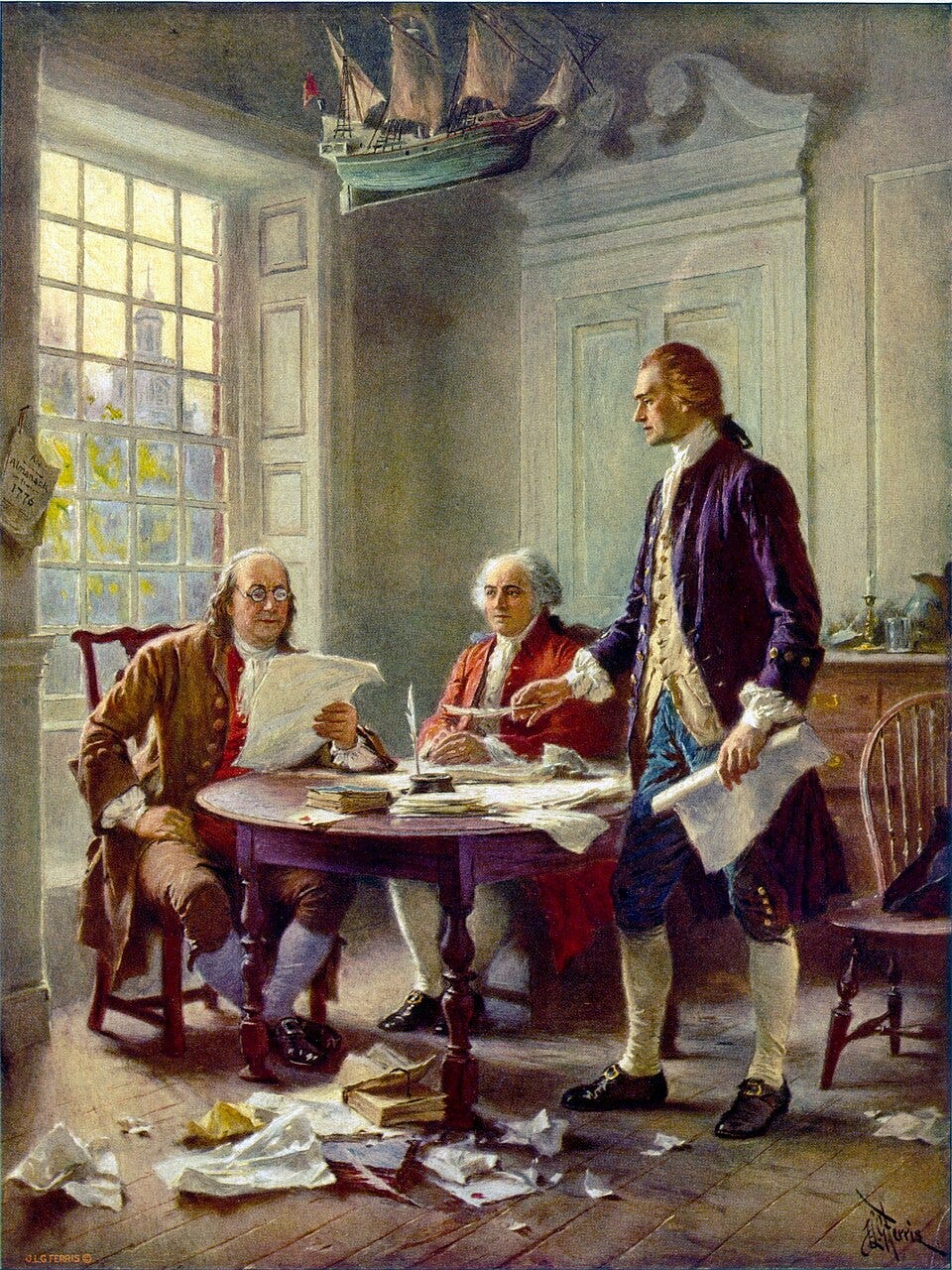
The Declaration of Independence is one of the most pivotal documents in world history. It not only changed the course of 13 colonies into what would become the United States of America, but became one of the foundational statements of liberty and self-government across the world. Drafted principally by Thomas Jefferson, then reviewed and revised by Benjamin Franklin, John Adams, the Committee of Five, and ultimately the Continental Congress, they would become an echo that continues to ring through the ages, now 250 years later.
It was not just crucial because it said the American British colonies were no longer recognizing themselves as British subjects and Englishmen to the largest and most powerful empire of the time, but that they were recognizing themselves jointly under a philosophical and theological perspective, saying that they ought to become “separate and equal station to which the Laws of Nature and of Nature’s God entitle them.” Continueing that “we hold these truths to be self-evident, that all men are created equal, that they are endowed by their Creator with certain unalienable Rights, that among these are Life, Liberty and the pursuit of Happiness.”
This document was revolutionary, pun intended, when they were written because they went against the medieval notion of the divine right of kings to rule, and proposed that government derives “their just powers from the consent of the governed. — That whenever any Form of Government becomes destructive of theses ends, it is the Right of the People to alter or to abolish it, and to institute new Government, laying its foundation on such principles and organization its powers in such form, as to them shall seem most likely to effect their Safety and Happiness.”
People saw this document as an over reach on the colonists part, but after “a long train of abuses and usurpations,” and “a history of repeated injuries” by the King of Great Britain, it “is their right, it is their duty, to throw off such Government, and to provide new Guards for their future security.” It is often forgotten that they were not just rebelling against King George III of England, but they were claiming that their rights did not come from the king because he allowed them when it pleased him, but they were created equal by their Creator. That when they, as Representatives of their states, “appealing to the Supreme Judge of the world….and for the support of this Declaration, with a firm reliance on the protection of divine Providence” (Emphasis added) 2. This distinction and strategic wording was not just a divorce from their parent country but was a declaration of their faith in God thus being the basis that they saw from where their rights came from, their Lawgiver , their Judge and their Righteous King, pointing scripturally to Jesus Christ. And this perspective is the forgotten truth and important distinction when comparing this declaration of independence to others.
🏛️ Wisdom Through the Ages
Excerpt from the Declaration of Independence itself:
“When in the Course of human events, it becomes necessary for one people to dissolve the political bands which have connected them with another, and to assume among the powers of the earth, the separate and equal station to which the Laws of Nature and of Nature’s God entitle them, a decent respect to the opinions of mankind requires that they should declare the causes which impel them to the separation.
We hold these truths to be self-evident, that all men are created equal, that they are endowed by their Creator with certain unalienable Rights, that among these are Life, Liberty and the pursuit of Happiness.--That to secure these rights, Governments are instituted among Men, deriving their just powers from the consent of the governed, --That whenever any Form of Government becomes destructive of these ends, it is the Right of the People to alter or to abolish it, and to institute new Government, laying its foundation on such principles and organizing its powers in such form, as to them shall seem most likely to effect their Safety and Happiness.” 2
💭 One Thought to Ponder
“For the support of this Declaration, with a firm reliance on the protection of divine Providence, we mutually pledge to each other our Lives, our Fortunes and our sacred Honor.”
— Last Sentence of the Declaration of Independence 2
❓Questions to Consider
If our rights are endowed by our Creator rather than granted by government, what responsibilities come with those rights?
The Founders pledged their “Lives,” “Fortunes,” and “sacred Honor” to support the Declaration. What are we willing to sacrifice to preserve the principles and liberties we have inherited from those who came before us?
Thank you for reading Volume 2026 | Issue No. 11 of The Weekly Landing.
If this issue was meaningful to you, consider subscribing and sharing it with others who may benefit from reflections on Scripture, theology, history, philosophy, and the enduring ideas that have shaped Christian civilization and the American Story.
New issues are published every Wednesday.
About The Weekly Landing
The Weekly Landing is a weekly publication of History Landing 1620, dedicated to exploring Scripture, theology, history, philosophy, and the ideas that have shaped Christian civilization and the American Story.
Every issue of The Weekly Landing will always remain free. Supporting subscriptions help sustain this publication and advance the long-term mission of History Landing 1620 through publishing, education, historical preservation, museums, and lifelong learning.
Timeless Wisdom. Faithful Living. A Legacy Worth Leaving.
Recovering the Christian Roots of America.
Published by History Landing 1620
Sources & Citations
1. Scripture
Scripture quotations are from the Holy Bible, New International Version® (NIV®). Copyright © 1973, 1978, 1984, 2011 by Biblica, Inc.® Used by permission. All rights reserved worldwide.
2. Historical Quotation, Wisdom Through the Ages and Quote
Declaration of Independence, July 4, 1776. National Archives, America's Founding Documents. Transcription of the original parchment, with spelling and punctuation preserved. National Archives — Declaration of Independence: A Transcription
3. Image
Jean Leon Gerome Ferris, Writing the Declaration of Independence, 1776, oil on canvas, c. 1900. The painting depicts Thomas Jefferson, Benjamin Franklin, and John Adams meeting at Jefferson’s Philadelphia lodgings to review a draft of the Declaration of Independence. Reproduction held by the Library of Congress, Prints and Photographs Division, digital ID cph.3g09904, reproduction number LC-USZC4-9904. No known restrictions on publication. Library of Congress — Writing the Declaration of Independence, 1776
© 2026 Tyler Anthony Loiselle. Published by History Landing 1620. All Rights Reserved.