


The Declaration of Independence
By Thomas Jefferson and the Continental Congress
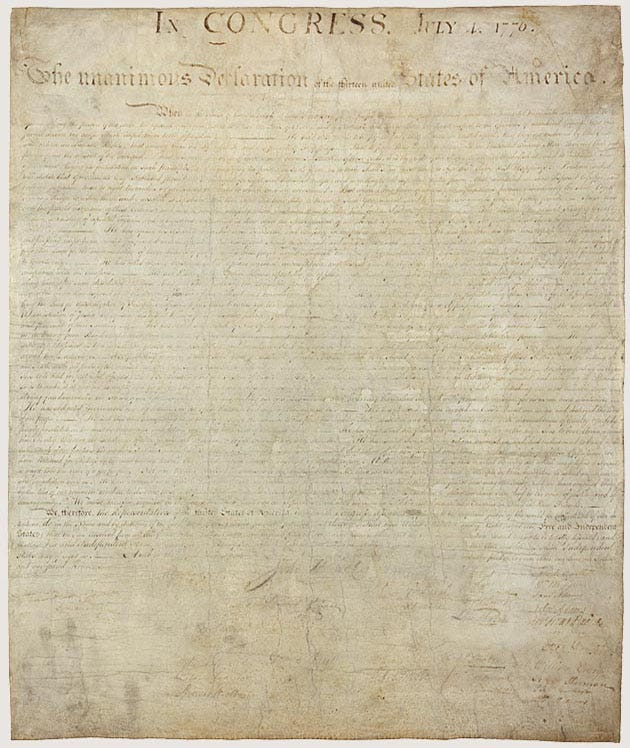
Adopted on July 4, 1776, The Declaration of Independence is one of the most consequential documents in American history. While Thomas Jefferson drafted the initial document, its final form was the product of revision and approval by the Committee of Five and the Continental Congress.
It is easy to remember the Declaration simply as America’s announcement of independence from Great Britain. But to read the document carefully is to discover that it was doing something much greater.
The Declaration did not merely argue that the colonies should be politically independent. It presented a philosophical and theological argument about the nature and source of human rights and legitimate government.
The authors appealed to the “Laws of Nature and of Nature’s God,” declared that “all men are created equal,” and affirmed that human beings are “endowed by their Creator with certain unalienable Rights.” Government, therefore, does not create these rights. Rather, government exists to secure them.
The Declaration then concludes by appealing to the “Supreme Judge of the world” and placing its confidence in the “protection of divine Providence.”
These references are not incidental. They reveal the framework through which the Founders understood liberty: human dignity comes from the Creator, legitimate government is accountable to a higher law, and political freedom carries with it moral responsibility.
For readers seeking to understand the foundations of the American experiment—and especially the forgotten theological dimension of American independence—the Declaration itself remains an essential primary source.
Why read it?
Because before reading what later generations have said about America’s founding, we should first read what the Founders actually wrote.
The Declaration challenges us to consider not only what rights we possess, but where those rights come from, what government is for, and what responsibilities accompany the liberty we have inherited.
“We hold these truths to be self-evident, that all men are created equal, that they are endowed by their Creator with certain unalienable Rights.”
— Declaration of Independence, July 4, 1776
Recommended Reading: The Declaration of Independence
Best place to begin: Read the Declaration from beginning to end without treating it merely as a collection of famous quotations. Pay particular attention to its references to God, the Creator, natural law, rights, government, consent, justice, and Providence.
Then read it a second time, asking a simple question: What does this document assume about God, humanity, government, and liberty?
A thought worth carrying with you:
If our rights are not ultimately granted by government, but endowed by our Creator, then liberty is more than the freedom to do whatever we desire. It is a responsibility to live in accordance with truth, justice, and the moral order upon which liberty depends.
About The Weekly Landing
The Weekly Landing is the flagship publication of History Landing 1620, exploring Scripture, history, philosophy, and the ideas that have shaped Christian civilization and the American Story.
While The Weekly Landing’s regular Wednesday newsletter will always remain free, this publication may also include additional essays, book recommendations, historical resources, and other special features published throughout the year. These pieces are part of the broader work of History Landing 1620 and its mission to encourage thoughtful reading, historical understanding, faithful living, and lifelong learning.
Through The Weekly Landing, History Landing 1620 seeks to recover the wisdom of the past and apply it faithfully to the present—preserving the lessons, ideas, books, and principles worth passing on to the next generation.
Timeless Wisdom. Faithful Living. A Legacy Worth Leaving.
Recovering the Christian Roots of America.
Published by History Landing 1620
Sources
1. Image
Declaration of Independence, July 4, 1776. National Archives, America’s Founding Documents. Transcription of the original parchment, with spelling and punctuation preserved. National Archives — Declaration of Independence: A Transcription
© 2026 Tyler Anthony Loiselle. Published by History Landing 1620. All Rights Reserved.