

Welcome to the thirteenth issue of The Weekly Landing.
If you’re joining us for the first time, welcome. Each week we’ll spend time exploring timeless wisdom from Scripture, Christian theology, history, philosophy, and the great works that have shaped Christian civilization and the American story.
The goal is simple: to help people think deeply, live faithfully, and preserve the inheritance of biblical truth for the next generation.
This week’s passages consider a question that reaches from the freedom found in Christ to the liberty sought by the founders of the American republic: What does it mean to be truly free—and what responsibilities and sacrifices does freedom demand of those entrusted with it?
✝️ Scripture This Week
1 Corinthians 10:23-24
23 “I have the right to do anything,” you say—but not everything is beneficial. “I have the right to do anything”—but not everything is constructive. 24 No one should seek their own good, but the good of others.
2 Corinthians 5:14-15
14 For Christ’s love compels us, because we are convinced that one died for all, and therefore all died. 15 And he died for all, that those who live should no longer live for themselves but for him who died for them and was raised again.
Galatians 5:13-15; 19-25
13 You, my brothers and sisters, were called to be free. But do not use your freedom to indulge the flesh; rather, serve one another humbly in love. 14 For the entire law is fulfilled in keeping this one command: “Love your neighbor as yourself.” 15 If you bite and devour each other, watch out or you will be destroyed by each other.
19 The acts of the flesh are obvious: sexual immorality, impurity and debauchery; 20 idolatry and witchcraft; hatred, discord, jealousy, fits of rage, selfish ambition, dissensions, factions 21 and envy; drunkenness, orgies, and the like. I warn you, as I did before, that those who live like this will not inherit the kingdom of God.
22 But the fruit of the Spirit is love, joy, peace, forbearance, kindness, goodness, faithfulness, 23 gentleness and self-control. Against such things there is no law. 24 Those who belong to Christ Jesus have crucified the flesh with its passions and desires. 25 Since we live by the Spirit, let us keep in step with the Spirit.
2 Corinthians 3:17
17 Now the Lord is the Spirit, and where the Spirit of the Lord is, there is freedom. 1 (Emphasis Added)
📜 Historical Anecdote This Week
Henry’s Liberty or Death, The Choice is Now Ours
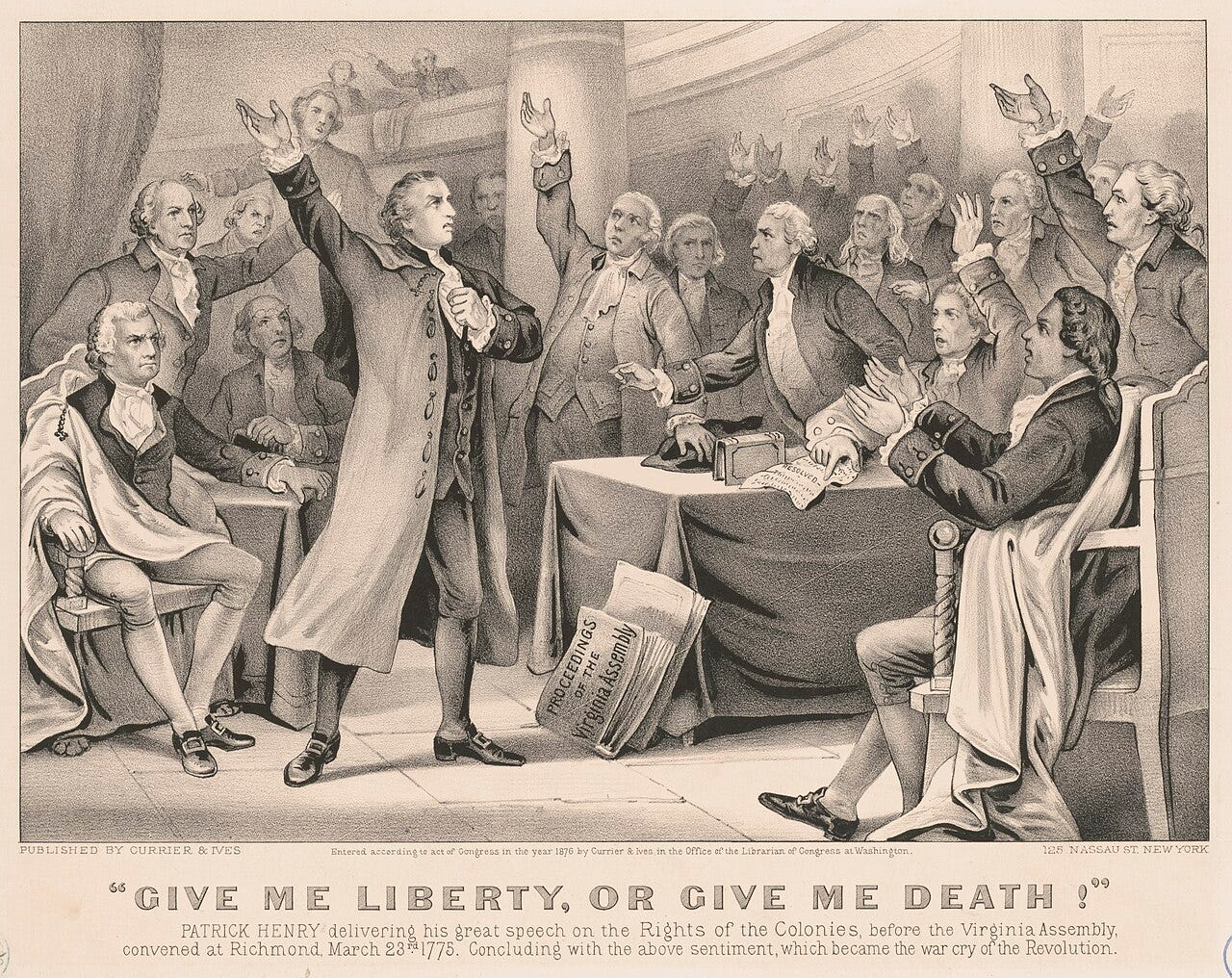
Patrick Henry is often quoted from his famous speech “Give me liberty, or give me death,” but his ideas were much larger than a seven word phrase. He argued that being weighed down by chains of bondage is worst than death, but what comes with liberty you may ask.
Now on the verge of the American Revolution, he would be a motivator that would be a ideological push towards American Independence. He was a man that could speak to the hearts of the masses and commanded the attention of all those who listened. He would make his case in the Virginia House in his famed speech on March 23, 1775 by describing the current national climate:
“This was no time for ceremony. The question before the house was one of awful moment to this country. For his own part, he considered it as nothing less than a question of freedom or slavery. And in proportion to the magnitude of the subject, ought to be the freedom of the debate. It was only in this way that they could hope to arrive at truth, and fulfil the great responsibility which they held to God and their country. Should he keep back his opinions at such a time, through fear of giving offence, he should consider himself as guilty of treason towards his country, and of an act of disloyalty toward the majesty of Heaven, which he revered above all earthly kings.”
Restating their past actions with Great Britain and how they were to no avail, Henry continued:
“They [the English army and navy] are sent over to bind and rivet upon us those chains which the British ministry have been so long forging. And what have we to oppose to them? Shall we try argument? Sir, we have been trying that for the last ten years. Have we anything new to offer upon the subject? Nothing. We have held the subject up in every light of which it is capable; but it has been all in vain. Shall we resort to entreaty and humble supplication? What terms shall we find which have not been already exhausted? Let us not, I beseech you, sir, deceive ourselves. Sir, we have done everything that could be done to avert the storm which is now coming on. We have petitioned; we have remonstrated; we have supplicated; we have prostrated ourselves before the throne, and have implored its interposition to arrest the tyrannical hands of the ministry and Parliament. Our petitions have been slighted; our remonstrances have produced additional violence and insult; our supplications have been disregarded; and we have been spurned, with contempt, from the foot of the throne! In vain, after these things, may we indulge the fond hope of peace and reconciliation. There is no longer any room for hope. If we wish to be free-- if we mean to preserve inviolate those inestimable privileges for which we have been so long contending--if we mean not basely to abandon the noble struggle in which we have been so long engaged, and which we have pledged ourselves never to abandon until the glorious object of our contest shall be obtained--we must fight! I repeat it, sir, we must fight! An appeal to arms and to the God of hosts is all that is left us!” 2
Henry argues what good is living if there is no choice but to live submissive to something that has proved deadly and destructive? Like the Apostle Paul says in First Corinthians to help to define freedom as being able to do what you want but simultaneously knowing and grasping that not everything is beneficial and will ultimately come at a cost. All decisions, good and bad, have a price, an effect that follows them. As the old American maxim says “freedom is not free.” Our Founding Fathers and Mothers knew it would come at a cost which they were willing to pay, along with those brave men and women who went before us in the line of duty paid often times with their own lives to secure our freedoms which we can exercise and choose to live out. In the similar way theologically, Christ died for our sins, and we too have the choice to chose Him. When we choose Him, as born-again Christians, we have the choice and decision on whether to live obediently to His commands on how we will live our lives for Him after that or not. It is our solely our decision to make.
🏛️ Wisdom Through the Ages
“It is in vain, sir, to extenuate the matter. Gentlemen may cry, Peace, Peace-- but there is no peace. The war is actually begun! The next gale that sweeps from the north will bring to our ears the clash of resounding arms! Our brethren are already in the field! Why stand we here idle? What is it that gentlemen wish? What would they have? Is life so dear, or peace so sweet, as to be purchased at the price of chains and slavery? Forbid it, Almighty God! I know not what course others may take; but as for me, give me liberty or give me death!”
— Patrick Henry, March 23, 1775 2 (Emphasis Added)
Henry’s question was spoken in the context of the American struggle for independence, but it raises a question that reaches beyond the battlefield: What is freedom worth, and what are we willing to sacrifice to preserve it? Scripture adds another dimension. If Christ has set us free, then our freedom is not merely freedom from something—it is freedom for something: to walk by the Spirit, serve others in love, practice self-control, and no longer live merely for ourselves.
💭 One Thought to Ponder
“A Christian man is the most free lord of all, and subject to none; a Christian man is the most dutiful servant of all, and subject to every one.”
— Martin Luther, The Freedom of a Christian, 1520 4
Luther’s words capture the paradox at the heart of Christian liberty: freedom does not ultimately mean living for oneself. The Christian is freed from bondage to sin so that he may freely love and serve his neighbor. In this sense, liberty and responsibility are not opposites. True freedom makes self-government possible because it teaches us not merely to ask, “What am I free to do?” but also, “What ought I to do for the good of others?”
❓Questions to Consider
If true freedom is found in Christ, what are we actually being freed from—and what are we being freed for?
What is freedom worth sacrificing for—and what is it not worth sacrificing for?
Thank you for reading Volume 2026 | Issue No. 13 of The Weekly Landing.
If this issue was meaningful to you, consider subscribing and sharing it with others who may benefit from reflections on Scripture, theology, history, philosophy, and the enduring ideas that have shaped Christian civilization and the American Story.
New issues are published every Wednesday.
About The Weekly Landing
The Weekly Landing is a weekly publication of History Landing 1620, dedicated to exploring Scripture, theology, history, philosophy, and the ideas that have shaped Christian civilization and the American Story.
Every issue of The Weekly Landing will always remain free. Supporting subscriptions help sustain this publication and advance the long-term mission of History Landing 1620 through publishing, education, historical preservation, museums, and lifelong learning.
Timeless Wisdom. Faithful Living. A Legacy Worth Leaving.
Recovering the Christian Roots of America.
Published by History Landing 1620
Sources & Citations
1. Scripture
Scripture quotations are from the Holy Bible, New International Version® (NIV®). Copyright © 1973, 1978, 1984, 2011 by Biblica, Inc.® Used by permission. All rights reserved worldwide.
2. Historical Quotation, Wisdom Through the Ages
3. Image
Currier & Ives, “Give me liberty, or give me death!” Patrick Henry delivering his great speech on the rights of the colonies, before the Virginia Assembly, convened at Richmond, March 23rd 1775, 1876, lithograph, Library of Congress, Prints and Photographs Division, Digital ID cph.3b50326. Image accessed through Wikimedia Commons; original collection record: Library of Congress. Library of Congress: https://www.loc.gov/pictures/resource/cph.3b50326/
4. Quote
Martin Luther, The Freedom of a Christian (De Libertate Christiana), 1520, in Henry Wace and C. A. Buchheim, eds., First Principles of the Reformation or the Ninety-Five Theses and the Three Primary Works of Martin Luther (London: John Murray, 1883), 104–118. Digital text available through the Christian Classics Ethereal Library. https://ccel.org/ccel/luther/christianliberty.iii.html
© 2026 Tyler Anthony Loiselle. Published by History Landing 1620. All Rights Reserved. Publication scheduled in advance.