


Welcome to the eighth issue of The Weekly Landing.
If you’re joining us for the first time, welcome. Each week we’ll spend time exploring timeless wisdom from Scripture, Christian theology, history, philosophy, and the great works that have shaped Christian civilization and the American story.
The goal is simple: to help people think deeply, live faithfully, and preserve the inheritance of biblical truth for the next generation.
Let’s begin.
✝️ Scripture This Week
Mark 9:42
“If anyone causes one of these little ones—those who believe in me—to stumble, it would be better for them if a large millstone were hung around their neck and they were thrown into the sea….”
Jeremiah 6:16
16 This is what the Lord says:
“Stand at the crossroads and look; ask for the ancient paths, ask where the good way is, and walk in it, and you will find rest for your souls. But you said, ‘We will not walk in it.’”
Hosea 4:6
5 You stumble day and night, and the prophets stumble with you. So I will destroy your mother—6 my people are destroyed from lack of knowledge. “Because you have rejected knowledge, I also reject you as my priests; because you have ignored the law of your God, I also will ignore your children. 7 The more priests there were, the more they sinned against me; they exchanged their glorious God for something disgraceful. 8 They feed on the sins of my people and relish their wickedness. 9 And it will be: Like people, like priests. I will punish both of them for their ways and repay them for their deeds. (Emphasis added) 1
📜 Historical Anecdote This Week
The Pursuit of Knowledge and God Honoring Worship
In the 1300s, John Wycliffe became one of England’s most important critics of the growing power of the papacy. He believed that the Church should be faithful to Jesus Christ and the teachings of Scripture, rather than allowing the pope and church authorities to exercise power beyond what Scripture permitted. His teachings challenged both religious and political authority, bringing him into conflict with church leaders.
Wycliffe believed that Christians needed to know the Bible for themselves. With the help of his followers, the Bible was translated into English so that ordinary people could hear and read God’s Word in their own language. Wycliffe and those who followed his teachings faced opposition and condemnation, but his influence continued throughout England through the Lollards movement, who preached and taught from Scripture.
“A great change was now taking place in the reformer. Busying himself less about the kingdom of England, he occupied himself more about the kingdom of Christ. In him the political phasis was followed by the religious. To carry the glad tidings of the gospel into the remotest hamlets was now the great idea which possessed Wickliffe. If begging friars, said he, stroll over the country preaching the legions of saints and the history of the Trojan war, we must do for God’s glory what they do to fill their wallets, and form a vast itinerant evangelization to convert souls to Jesus Christ. Turning to the most pious of his disciples he said to them, “Go and preach; it is the sublimest work; but imitate not the priest whom we see after the sermon sitting in the alehouses, or at the gaming-table, or wasting their time in hunting. After your sermon is ended, do you visit the sick, the aged, the poor, the blind, and the lame, and succor [support] them according to your ability.” Such was a new practical theology which Wickliffe inaugurated-it was that of Christ himself.” 2
The later Church of England did not yet exist, so it would be inaccurate to call Wycliffe an Anglican. However, his movement became part of the longer history of English Christianity that became part of the longer story of English religious reform. At the heart of his work was a simple conviction: Christ is the head of His Church, and God’s people need to know and follow His Word.
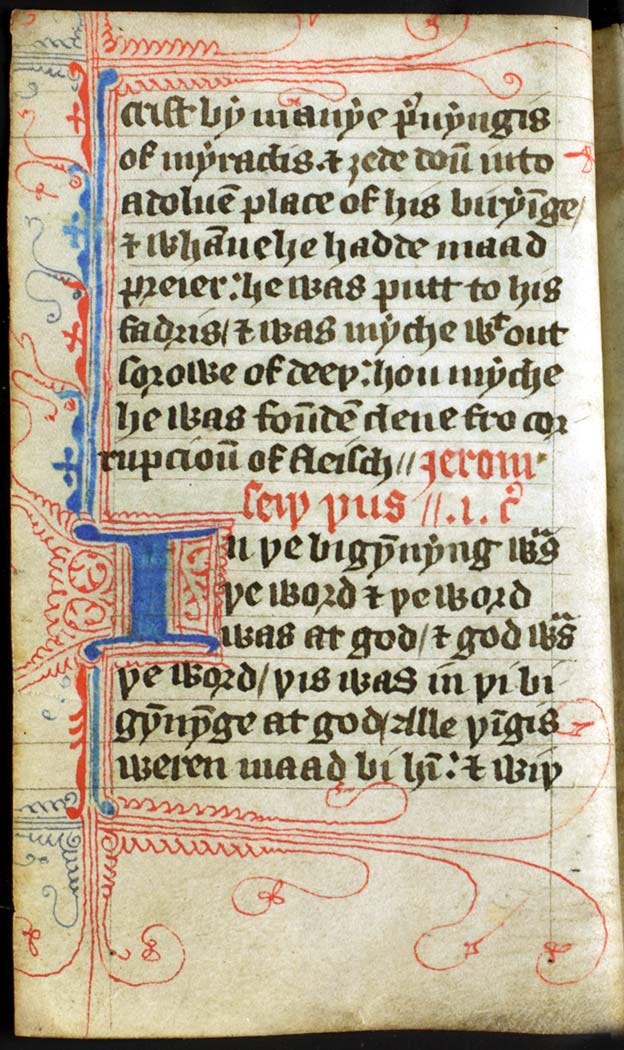
The Wycliffite manuscript pictured here reminds us that God’s Word was preserved and passed from one generation to another. Wycliffe’s story therefore fits the message of this week’s Scripture: we must not forget what we have received, but faithfully learn it, live it, and pass it on to those who come after us. We must not change or distort God’s Word for our benefit or for the harm of those around us for our personal control, but we preach and live it faithfully as a pleasing aroma to the Father.
🏛️ Wisdom Through the Ages
Excerpt from Matthew Henry and His Bible Commentary
Reflecting on Hosea 4:6, Matthew Henry discusses the destruction that comes when God’s people reject knowledge.
“Note, Those that rebel against the light can expect no other than to perish in the dark. Or it is a charge upon the priests, who should have been still teaching the people knowledge (Eccl. 12:9), but they did not, or did it in such a manner that it was as if they had not done it at all, so there was no knowledge of God in the land; and because there was no vision, or none to any purpose, the people perished, Prov. 29:18. Note, Ignorance is so far from being the mother of devotion that it is the mother of destruction; lack of knowledge is ruining to any person or people. They are my people that are thus destroyed; their relation to God as his people aggravates both their sin in not taking pains to get the knowledge of that God whose command they were under and with whom they were taken into covenant, and likewise the sin of those who should have taught them; God set his children to school to them, and they never minded them nor took any pains with them.” 4
💭 One Thought to Ponder
“It is in the Interest of Tyrants to reduce the People to Ignorance and Vice. For they cannot live in any Country where Virtue and Knowledge prevail. The Religion and public Liberty of a People are intimately connected; their Interests are interwoven, they cannot subsist separately; and therefore they rise and fall together.” (Emphasis added)
— Samuel Adams, writing as “Valerius Poplicola,” Boston Gazette, October 5, 1772. 5
❓Questions to Consider
Where do you need to increase in your knowledge of God and His Word?
In what areas of your life do you need to better teach and speak about the knowledge of God to those around you?
Thank you for reading Volume 2026 | Issue No. 8 of The Weekly Landing.
If this issue was meaningful to you, consider subscribing and sharing it with others who may benefit from reflections on Scripture, theology, history, philosophy, and the enduring ideas that have shaped Christian civilization and the American Story.
New issues are published every Wednesday.
About The Weekly Landing
The Weekly Landing is the flagship publication of History Landing 1620, exploring Scripture, history, philosophy, and the ideas that have shaped Christian civilization and the American Story.
While The Weekly Landing’s regular Wednesday newsletter will always remain free, this publication may also include additional essays, book recommendations, historical resources, and other special features published throughout the year. These pieces are part of the broader work of History Landing 1620 and its mission to encourage thoughtful reading, historical understanding, faithful living, and lifelong learning.
Through The Weekly Landing, History Landing 1620 seeks to recover the wisdom of the past and apply it faithfully to the present—preserving the lessons, ideas, books, and principles worth passing on to the next generation.
Timeless Wisdom. Faithful Living. A Legacy Worth Leaving.
Recovering the Christian Roots of America.
Published by History Landing 1620
Sources & Citations
1. Scripture
Scripture quotations are from the Holy Bible, New International Version® (NIV®). Copyright © 1973, 1978, 1984, 2011 by Biblica, Inc.® Used by permission. All rights reserved worldwide.
2. Historical Quotation
d’Aubigné, J. H. Merle. History of the Reformation of the Sixteenth Century. Translated by H. White, B.A. Vol. V. New York: American Tract Society, no date, 104–105.
3. Image
4. Wisdom Through the Ages
Matthew Henry, Matthew Henry’s Commentary on the Whole Bible. Accessed via Bible Hub. https://biblehub.com/commentaries/mhcw/hosea/4.htm
5. Quote
Samuel Adams, “Valerius Poplicola,” Boston Gazette, October 5, 1772, in The Writings of Samuel Adams, 1770–1773, ed. Harry Alonzo Cushing, vol. 2 (New York: G. P. Putnam’s Sons, 1904), 336–337.
© 2026 Tyler Anthony Loiselle. Published by History Landing 1620. All Rights Reserved.