

Welcome to the fifteenth issue of The Weekly Landing.
If you’re joining us for the first time, welcome. Each week we’ll spend time exploring timeless wisdom from Scripture, Christian theology, history, philosophy, and the great works that have shaped Christian civilization and the American story.
The goal is simple: to help people think deeply, live faithfully, and preserve the inheritance of biblical truth for the next generation.
This week's passages consider a question that reaches from ancient civilizations to the founding of the American republic: What kind of people are capable of governing themselves—and therefore capable of preserving a free government?
✝️ Scripture This Week
Proverbs 25:28
28 Like a city whose walls are broken through is a person who lacks self-control.
Proverbs 4:23
23 Above all else, guard your heart, for everything you do flows from it.
2 Peter 1:3-11
3 His divine power has given us everything we need for a godly life through our knowledge of him who called us by his own glory and goodness. 4 Through these he has given us his very great and precious promises, so that through them you may participate in the divine nature, having escaped the corruption in the world caused by evil desires.
5 For this very reason, make every effort to add to your faith goodness; and to goodness, knowledge; 6 and to knowledge, self-control; and to self-control, perseverance; and to perseverance, godliness; 7 and to godliness, mutual affection; and to mutual affection, love. 8 For if you possess these qualities in increasing measure, they will keep you from being ineffective and unproductive in your knowledge of our Lord Jesus Christ. 9 But whoever does not have them is nearsighted and blind, forgetting that they have been cleansed from their past sins.
10 Therefore, my brothers and sisters, make every effort to confirm your calling and election. For if you do these things, you will never stumble, 11 and you will receive a rich welcome into the eternal kingdom of our Lord and Savior Jesus Christ.
Titus 2:1-8
You, however, must teach what is appropriate to sound doctrine. 2 Teach the older men to be temperate, worthy of respect, self-controlled, and sound in faith, in love and in endurance.
3 Likewise, teach the older women to be reverent in the way they live, not to be slanderers or addicted to much wine, but to teach what is good. 4 Then they can urge the younger women to love their husbands and children, 5 to be self-controlled and pure, to be busy at home, to be kind, and to be subject to their husbands, so that no one will malign the word of God.
6 Similarly, encourage the young men to be self-controlled. 7 In everything set them an example by doing what is good. In your teaching show integrity, seriousness 8 and soundness of speech that cannot be condemned, so that those who oppose you may be ashamed because they have nothing bad to say about us. 1
📜 Historical Anecdote This Week
Washington and the Virtue of Self-Control
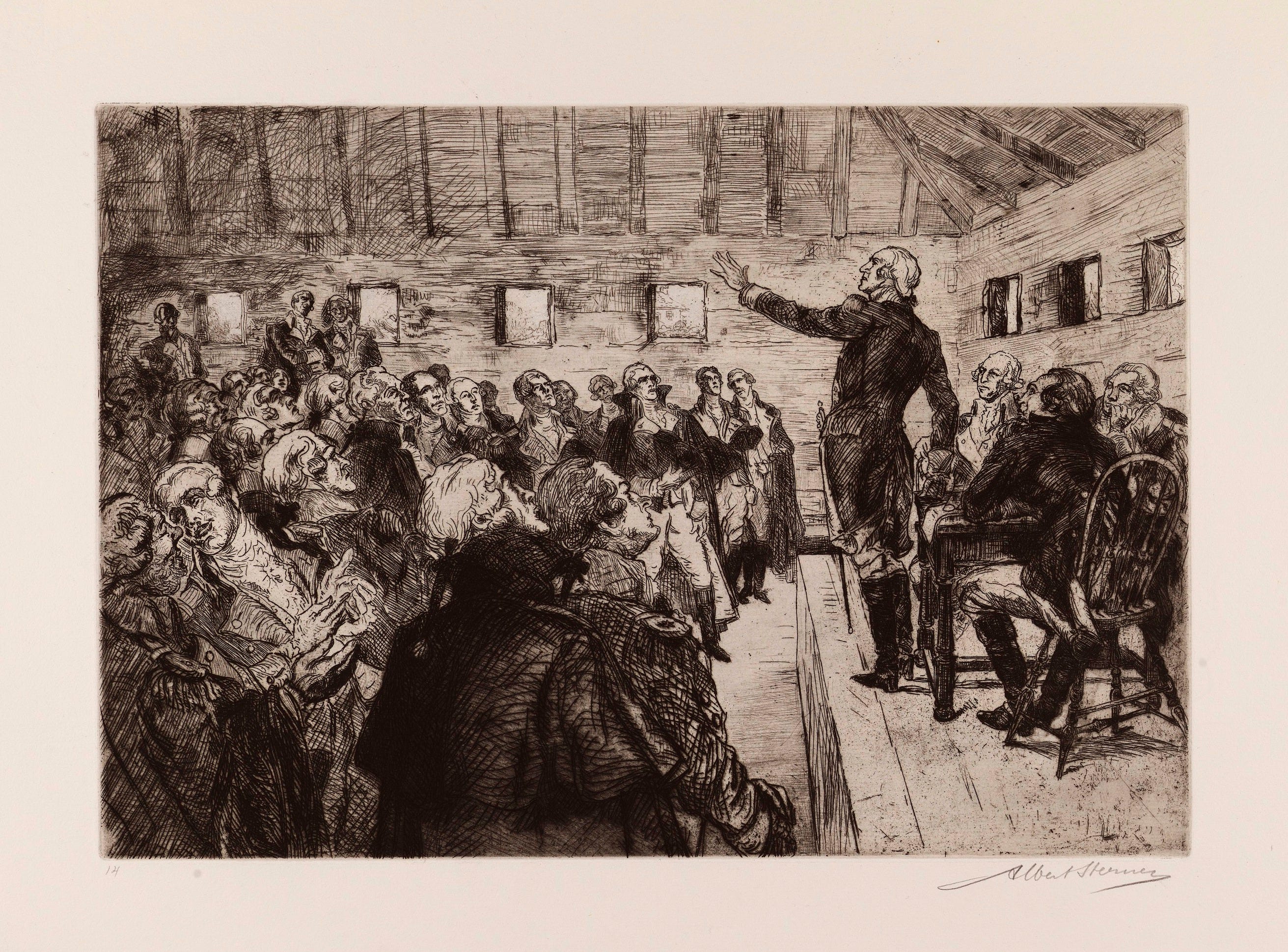
In March 1783, the Revolutionary War was nearly over, but the Continental Army was deeply frustrated. Soldiers and officers had gone without promised pay, and some officers were considering using the army’s power to pressure Congress. The danger was serious: the army that had fought for a republic could now become a threat to the civilian government of that republic.
George Washington addressed his officers at Newburgh, New York, on March 15. He acknowledged their grievances but urged them not to allow frustration to overcome their judgment. “Let me conjure you,” Washington told them, “in the name of our common Country, as you value your own sacred honor, to express your utmost horror and detestation of the man, who wishes, under any specious pretences, to overturn the liberties of our Country.”
Washington then appealed to something deeper than anger or self-interest. He reminded the officers that they had fought for the principles of the American cause and urged them to “give one more distinguished proof of unexampled patriotism.” Rather than use military power to force Congress to act, they were called to exercise restraint and remain faithful to the principles for which they had fought.
The Newburgh Crisis offers a powerful lesson in self-government. Having power does not mean that power should be used simply because it can be. Washington and his officers had legitimate grievances, but the greater question was whether they could govern their own anger and ambitions. A free people cannot depend entirely upon laws and institutions to restrain them; they must also possess the character to restrain themselves. As Washington’s example reminds us, sometimes preserving liberty requires the strength not to use the power we possess.
🏛️ Wisdom Through the Ages
Writing to James Warren in 1775, Samuel Adams reflected on the responsibility of governing a new and uncertain nation. He reminded Warren that military strength could defend a country, but only virtue could provide the foundation necessary to preserve its freedom.
“The Eyes of Mankind will be upon you, to see whether the Government, which is now more popular than it has been for many years past, will be productive of more Virtue moral and political. We may look up to Armies for our Defense, but Virtue is our best Security. It is not possible that any State should long continue free, where Virtue is not supremely honored…” 4 (Emphasis Added)
💭 One Thought to Ponder
In 1909, Theodore Roosevelt was reflecting on the development of self-government in the Philippines, which was then under American administration. While discussing whether self-government could simply be granted from the outside, Roosevelt pointed to a deeper principle: a free people must first develop the ability to govern themselves.
“In one sense of the word, self-government can never be bestowed by outsiders upon any people. It must be achieved by themselves. It means in this sense primarily self-control, self-restraint, and if those qualities do not exist—that is, if the people are unable to govern themselves—then, as there must be government somewhere, it has to come from outside.”
— Theodore Roosevelt, address at the celebration of the Methodist Episcopal Church, Washington, D.C., January 18, 1909 5 (Emphasis Added)
Although Roosevelt was speaking specifically about the Philippines, his observation raises a broader question that fits the theme of this week's issue: Can a people remain free if they cannot govern themselves? His answer was that self-government ultimately requires self-control and self-restraint.
❓Questions to Consider
What desires, emotions, or habits in your own life most challenge your ability to practice self-control and govern yourself?
If the preservation of a free society depends partly upon the character of its people, what responsibility do we have to cultivate virtue and self-government in ourselves and pass those qualities on to the next generation?
Thank you for reading Volume 2026 | Issue No. 15 of The Weekly Landing.
If this issue was meaningful to you, consider subscribing and sharing it with others who may benefit from reflections on Scripture, theology, history, philosophy, and the enduring ideas that have shaped Christian civilization and the American Story.
New issues are published every Wednesday.
About The Weekly Landing
The Weekly Landing is a weekly publication of History Landing 1620, dedicated to exploring Scripture, theology, history, philosophy, and the ideas that have shaped Christian civilization and the American Story.
Every issue of The Weekly Landing will always remain free. Supporting subscriptions help sustain this publication and advance the long-term mission of History Landing 1620 through publishing, education, historical preservation, museums, and lifelong learning.
Timeless Wisdom. Faithful Living. A Legacy Worth Leaving.
Recovering the Christian Roots of America.
Published by History Landing 1620
Sources & Citations
1. Scripture
Scripture quotations are from the Holy Bible, New International Version® (NIV®). Copyright © 1973, 1978, 1984, 2011 by Biblica, Inc.® Used by permission. All rights reserved worldwide.
2. Historical Quotation
Founders Online — Washington’s Newburgh Address
3. Image
Albert Sterner, Washington Prevents a Military Dictatorship, 1932, Smithsonian American Art Museum. Free to use. https://americanart.si.edu/artwork/washington-prevents-military-dictatorship-portfolio-bicentennial-pageant-george-washington
4. Wisdom Through the Ages
5. Quote
© 2026 Tyler Anthony Loiselle. Published by History Landing 1620. All Rights Reserved. Publication scheduled in advance.