

Welcome to the twelfth issue of The Weekly Landing.
If you’re joining us for the first time, welcome. Each week we’ll spend time exploring timeless wisdom from Scripture, Christian theology, history, philosophy, and the great works that have shaped Christian civilization and the American story.
The goal is simple: to help people think deeply, live faithfully, and preserve the inheritance of biblical truth for the next generation.
This week's passages consider a question that reaches from ancient Israel to the founding of the American republic: What is the proper relationship between God, government, and the people entrusted with authority?
✝️ Scripture This Week
Deuteronomy 1:9-18
9 At that time I [Moses] said to you [Israel], “You are too heavy a burden for me to carry alone. 10 The Lord your God has increased your numbers so that today you are as numerous as the stars in the sky. 11 May the Lord, the God of your ancestors, increase you a thousand times and bless you as he has promised! 12 But how can I bear your problems and your burdens and your disputes all by myself? 13 Choose some wise, understanding and respected men from each of your tribes, and I will set them over you.”
14 You answered me, “What you propose to do is good.”
15 So I took the leading men of your tribes, wise and respected men, and appointed them to have authority over you—as commanders of thousands, of hundreds, of fifties and of tens and as tribal officials. 16 And I charged your judges at that time, “Hear the disputes between your people and judge fairly, whether the case is between two Israelites or between an Israelite and a foreigner residing among you. 17 Do not show partiality in judging; hear both small and great alike. Do not be afraid of anyone, for judgment belongs to God. Bring me any case too hard for you, and I will hear it.” 18 And at that time I told you everything you were to do.
Isaiah 33:22
22 For the Lord is our judge, the Lord is our lawgiver, the Lord is our king; it is he who will save us.
Romans 13:1-7
1Let everyone be subject to the governing authorities, for there is no authority except that which God has established. The authorities that exist have been established by God. 2 Consequently, whoever rebels against the authority is rebelling against what God has instituted, and those who do so will bring judgment on themselves. 3 For rulers hold no terror for those who do right, but for those who do wrong. Do you want to be free from fear of the one in authority? Then do what is right and you will be commended. 4 For the one in authority is God’s servant for your good. But if you do wrong, be afraid, for rulers do not bear the sword for no reason. They are God’s servants, agents of wrath to bring punishment on the wrongdoer. 5 Therefore, it is necessary to submit to the authorities, not only because of possible punishment but also as a matter of conscience.
6 This is also why you pay taxes, for the authorities are God’s servants, who give their full time to governing. 7 Give to everyone what you owe them: If you owe taxes, pay taxes; if revenue, then revenue; if respect, then respect; if honor, then honor. 1
📜 Historical Anecdote This Week
Franklin, the Constitution, and the Character of a Free People
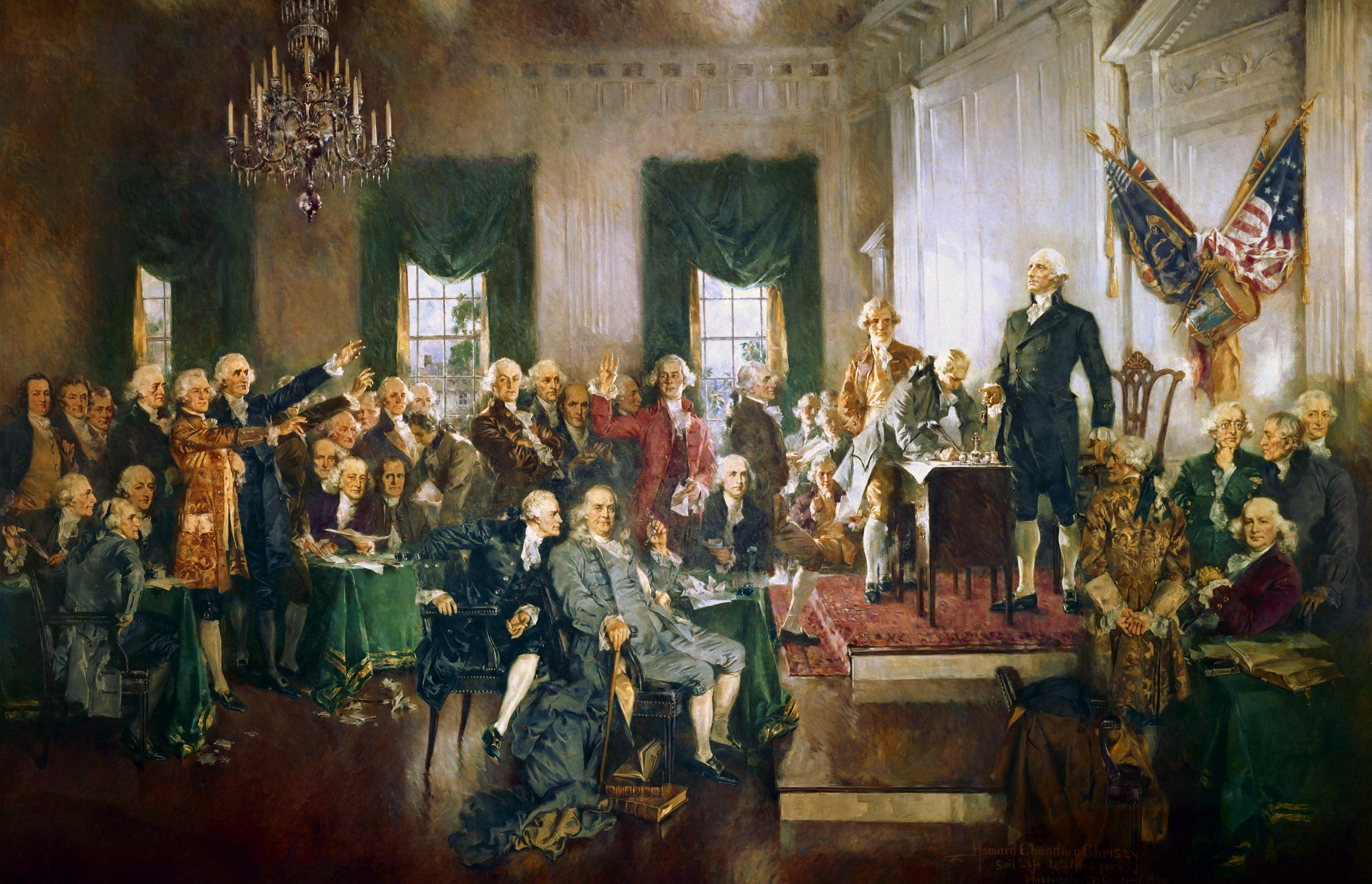
By June 1787, the delegates gathered in Philadelphia had spent weeks wrestling with the difficult question of how a new American government should be constructed. The debates were often contentious, and disagreements over representation threatened to divide the Convention. In the midst of this uncertainty, Benjamin Franklin rose on June 28 and urged the delegates to look beyond their own political wisdom. He reminded them that during the Revolution they had prayed together for divine protection—and that they had witnessed what he described as the workings of a “Superintending providence” in their favor.
Franklin then asked a question that has endured for generations:
“And have we now forgotten that powerful friend? or do we imagine that we no longer need his assistance? I have lived, Sir, a long time, and the longer I live, the more convincing proofs I see of this truth — that God governs in the affairs of men. And if a sparrow cannot fall to the ground without his notice, is it probable that an empire can rise without his aid?
We have been assured, Sir, in the sacred writings, that ‘except the Lord build the House they labour in vain that build it.’ I firmly believe this; and I also believe that without his concurring aid we shall succeed in this political building no better than the Builders of Babel.”
-Benjamin Franklin, June 28, 1787 (Emphasis Added) 2
He declared that without God’s “concurring aid,” their political undertaking would fare no better than the builders of Babel. His point was not that political wisdom was unnecessary, but that human wisdom alone was insufficient. The delegates could debate, compromise, and construct institutions—but they could not presume to build something lasting while forgetting the God they believed governed the affairs of men.
Franklin therefore proposed that the Convention begin each day’s proceedings with prayer, asking for the assistance of Heaven and its blessing upon their deliberations. The proposal was not adopted; the Library of Congress notes that the Convention declined it, citing the diversity of religious sects represented and the lack of funds for a chaplain. Yet Franklin’s appeal remains significant. A contemporary account by James McHenry, a delegate to the Constitutional Convention, records another memorable exchange with Franklin. On September 18, 1787, McHenry wrote that a woman identified as Mrs. Powel asked Franklin, “Well Doctor what have we got a republic or a monarchy?” Franklin replied, “A republic … if you can keep it.” 3
The Constitution had been completed, but preserving the republic would depend upon the people who inherited it. Franklin’s words point to a question that reaches beyond the document itself: What kind of people are necessary to preserve a free government?
That question brings us back to the words of John Adams more than a decade later. In 1798, Adams warned that the Constitution could not sustain itself merely through laws and institutions if the character of the people deteriorated. Franklin had warned that an empire could not rise without God’s aid; Adams warned that the Constitution was “wholly inadequate” to govern a people without morality and religion. Between the two stands the principle expressed by Rev. Matthew Henry that those entrusted with public authority are themselves servants of God, with work to perform and an account to render to Him. A free people, therefore, must consider not only how government is structured, but also the moral and spiritual character of those who govern—and of those who are governed.
🏛️ Wisdom Through the Ages
Excerpt from Matthew Henry and His Bible Commentary
Reflecting on Paul’s teaching in his epistle to the Romans concerning the roles of government, governors and the governed, Rev. Henry discusses the Christian’s duty to faithfully pursue the position he’s in, whether as a governor or as a member being governed:
“The powers that be: whatever the particular form and method of government are-whether by monarchy, aristocracy, or democracy-wherever the governing power is lodged, it is an ordinance of God, and it is to be received and submitted to accordingly; though immediately an ordinance of man (1 Pt. 2:13), yet originally an ordinance of God.—Ordained of God—tetagmenai; a military word, signifying not only the ordination of magistrates, but the subordination of inferior magistrates to the supreme, as in an army; for among magistrates there is a diversity of gifts, and trusts, and services…..This is not at all applicable to the particular rights of kings and kingdoms, and the branches of their constitution; nor can any certain rule be fetched from this for the modelling of the original contracts between the governors and governed; but it is intended for direction to private persons in their private capacity, to behave themselves quietly and peaceably in the sphere in which God has set them, with a due regard to the civil powers which God in his providence has set over them, 1 Tim. 2:1, 2. Magistrates are here again and again called God’s ministers. he is the minister of God, v. 4, 6. Magistrates are in a more peculiar manner God’s servants; the dignity they have calls for duty. Though they are lords to us, they are servants to God, have work to do for him, and an account to render to him. In the administration of public justice, the determining of quarrels, the protecting of the innocent, the righting of the wronged, the punishing of offenders, and the preserving of national peace and order, that every man may not do what is right in his own eyes-in these things it is that magistrates act as God’s ministers.” 5
💭 One Thought to Ponder
“While our Country remains untainted with the Principles and manners, which are now producing desolation in so many Parts of the World: while she continues Sincere and incapable of insidious and impious Policy: We shall have the Strongest Reason to rejoice in the local destination assigned Us by Providence. But should the People of America, once become capable of that deep simulation towards one another and towards foreign nations……this Country will be the most miserable Habitation in the World. Because We have no Government armed with Power capable of contending with human Passions unbridled by morality and Religion. Avarice, Ambition Revenge or Galantry, would break the strongest Cords of our Constitution as a Whale goes through a Net. Our Constitution was made only for a moral and religious People. It is wholly inadequate to the government of any other” (Emphasis Added)
— John Adams, October 11, 1798 6
❓Questions to Consider
If those who govern are ultimately accountable to God, how should that truth shape the way we understand authority, justice, and our own responsibilities as citizens?
What kind of moral and spiritual character is necessary for a free people to preserve the institutions they have inherited?
Thank you for reading Volume 2026 | Issue No. 12 of The Weekly Landing.
If this issue was meaningful to you, consider subscribing and sharing it with others who may benefit from reflections on Scripture, theology, history, philosophy, and the enduring ideas that have shaped Christian civilization and the American Story.
New issues are published every Wednesday.
About The Weekly Landing
The Weekly Landing is a weekly publication of History Landing 1620, dedicated to exploring Scripture, theology, history, philosophy, and the ideas that have shaped Christian civilization and the American Story.
Every issue of The Weekly Landing will always remain free. Supporting subscriptions help sustain this publication and advance the long-term mission of History Landing 1620 through publishing, education, historical preservation, museums, and lifelong learning.
Timeless Wisdom. Faithful Living. A Legacy Worth Leaving.
Recovering the Christian Roots of America.
Published by History Landing 1620
Sources & Citations
1. Scripture
Scripture quotations are from the Holy Bible, New International Version® (NIV®). Copyright © 1973, 1978, 1984, 2011 by Biblica, Inc.® Used by permission. All rights reserved worldwide.
2. Historical Quotation (Franklin according to Madison)
3. Historical Quotation (Franklin according to McHenry)
4. Image
Howard Chandler Christy, Scene at the Signing of the Constitution of the United States, 1940, oil on canvas, 20 × 30 feet, United States Capitol, House Wing, East Stairway. Commissioned by Congress in 1939 as part of the observance of the 150th anniversary of the U.S. Constitution and completed in 1940. Public-domain image. Information source: Architect of the Capitol. https://www.aoc.gov/explore-capitol-campus/art/signing-constitution Image source: https://en.wikipedia.org/wiki/Scene_at_the_Signing_of_the_Constitution_of_the_United_States#/media/File:Scene_at_the_Signing_of_the_Constitution_of_the_United_States.jpg

5. Wisdom Through the Ages
Matthew Henry, Matthew Henry’s Commentary on the Whole Bible. Accessed via Bible Hub. https://biblehub.com/commentaries/mhcw/romans/13.htm
6. Quote
From John Adams to Massachusetts Militia, 11 October 1798,” Founders Online, National Archives, https://founders.archives.gov/documents/Adams/99-02-02-3102.
© 2026 Tyler Anthony Loiselle. Published by History Landing 1620. All Rights Reserved. Publication scheduled in advance.