

Welcome to the ninth issue of The Weekly Landing.
If you’re joining us for the first time, welcome. Each week we’ll spend time exploring timeless wisdom from Scripture, Christian theology, history, philosophy, and the great works that have shaped Christian civilization and the American story.
The goal is simple: to help people think deeply, live faithfully, and preserve the inheritance of biblical truth for the next generation.
Let’s begin.
✝️ Scripture This Week
Luke 16:10-11
10 “Whoever can be trusted with very little can also be trusted with much, and whoever is dishonest with very little will also be dishonest with much. 11 So if you have not been trustworthy in handling worldly wealth, who will trust you with true riches?
Proverbs 22:7
The rich rule over the poor, and the borrower is slave to the lender.
Matthew 25:14-30
14 “Again, it will be like a man going on a journey, who called his servants and entrusted his wealth to them. 15 To one he gave five bags of gold, to another two bags, and to another one bag, each according to his ability. Then he went on his journey. 16 The man who had received five bags of gold went at once and put his money to work and gained five bags more. 17 So also, the one with two bags of gold gained two more. 18 But the man who had received one bag went off, dug a hole in the ground and hid his master’s money.
19 “After a long time the master of those servants returned and settled accounts with them. 20 The man who had received five bags of gold brought the other five. ‘Master,’ he said, ‘you entrusted me with five bags of gold. See, I have gained five more.’
21 “His master replied, ‘Well done, good and faithful servant! You have been faithful with a few things; I will put you in charge of many things. Come and share your master’s happiness!’
22 “The man with two bags of gold also came. ‘Master,’ he said, ‘you entrusted me with two bags of gold; see, I have gained two more.’
23 “His master replied, ‘Well done, good and faithful servant! You have been faithful with a few things; I will put you in charge of many things. Come and share your master’s happiness!’
24 “Then the man who had received one bag of gold came. ‘Master,’ he said, ‘I knew that you are a hard man, harvesting where you have not sown and gathering where you have not scattered seed. 25 So I was afraid and went out and hid your gold in the ground. See, here is what belongs to you.’
26 “His master replied, ‘You wicked, lazy servant! So you knew that I harvest where I have not sown and gather where I have not scattered seed? 27 Well then, you should have put my money on deposit with the bankers, so that when I returned I would have received it back with interest.
28 “‘So take the bag of gold from him and give it to the one who has ten bags. 29 For whoever has will be given more, and they will have an abundance. Whoever does not have, even what they have will be taken from them. 30 And throw that worthless servant outside, into the darkness, where there will be weeping and gnashing of teeth.’ 1
📜 Historical Anecdote This Week
The Art of Stewardship and the Game of Business
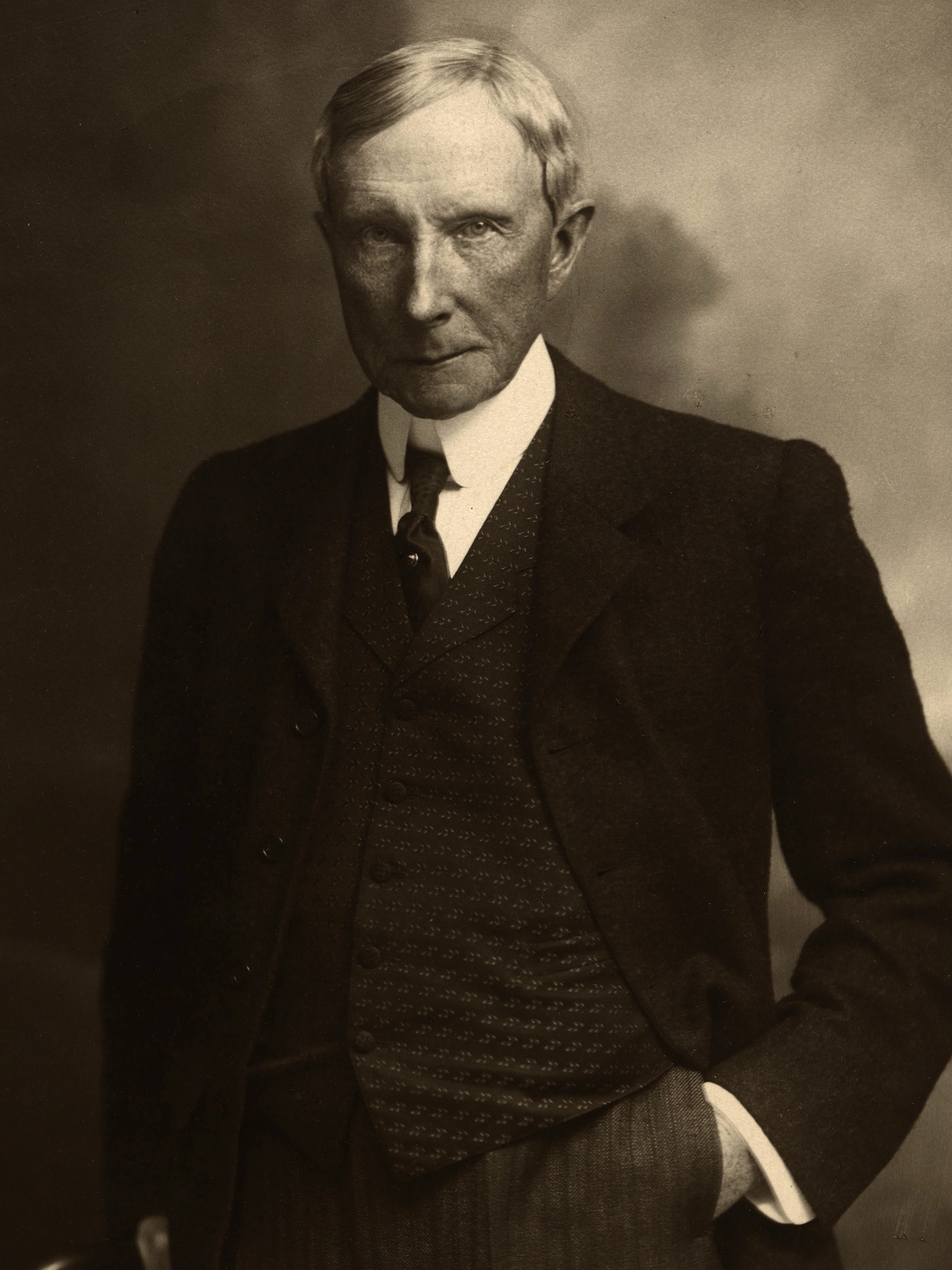
The American businessman and philanthropist John Davison Rockefeller was born in Richford, New York, in 1839 and grew up in modest circumstances. As a young man he developed habits that would remain with him throughout his life: careful accounting, disciplined saving, hard work, and a deep concern with where money went. In 1855, at only sixteen years old, he left school and found work as a bookkeeper in Cleveland. He quickly demonstrated an unusual ability to understand the financial side of business. Rockefeller did not initially dream of becoming the wealthiest American of his age; rather, he learned to treat business as something requiring order, discipline, patience, and careful stewardship. His career eventually led him into the oil industry, where he and his partners built what became the Standard Oil Company.
Rockefeller’s rise, however, was not without controversy. Standard Oil became enormously powerful, and Rockefeller’s methods of consolidation and control made him one of the most criticized businessmen in American history. His enormous fortune made him a symbol of the Gilded Age itself. Yet Rockefeller did not regard the accumulation of wealth as an end in itself. His religious convictions profoundly influenced the way he understood money. The famous statement attributed to him—that he believed the power to make money was “a gift of God” to be developed and used “for the good of mankind”—was reported in John T. Flynn’s God’s Gold (1932), where Flynn attributed it to an interview with William Hoster. Because the original interview transcript has not been located, it is best to identify Flynn’s book as the source rather than present the quotation as though we possess a surviving primary transcript.
There is, however, a primary-source foundation for this understanding of Rockefeller’s philosophy. In his own Random Reminiscences of Men and Events, published in 1909, Rockefeller reflected extensively upon both “the difficult art of getting” and “the difficult art of giving.” He described his business principles, the development of Standard Oil, and his later approach to philanthropy. The very structure of his memoir is revealing: Rockefeller placed the making of wealth and the giving of wealth within the same story. His own words and actions show a man who believed that financial ability brought responsibility with it. His fortune eventually funded enormous philanthropic efforts in education, medicine, public health, and other fields.
This brings Rockefeller’s story directly into the lesson of Matthew 25:14–30, where Christ tells of servants entrusted with different talents by their master. Rockefeller’s life therefore presents an intriguing historical case study in stewardship. His extraordinary financial abilities produced extraordinary wealth, but wealth itself did not answer the question of what that wealth was for. The Christian principle is more demanding than merely becoming successful: whatever God entrusts to us—money, ability, opportunity, knowledge, influence, or time—is ultimately something for which we are accountable to Him. The art of stewardship is therefore not simply the art of acquiring; it is the art of faithfully multiplying, wisely preserving, generously giving, and ultimately returning to the Master an account of what we did with what He placed in our hands.
🏛️ Wisdom Through the Ages
Excerpt from Matthew Henry and His Bible Commentary
Reflecting on the Parable of the Talents, Rev. Henry discusses the parallel between master and his servants with Christ and His followers.
“The Master is Christ, who is the absolute Owner and Proprietor of all persons and things…The servants are Christians, his own servants, so they are called; born in his house, bought with his money, devoted to his praise, and employed in his work…The trust committed to these servants; Their master delivered to them his goods: having appointed them to work (for Christ keeps no servants to be idle), he left them something to work upon. Note, 1. Christ’s servants have and receive their all from him; for they are of themselves worth nothing, nor have any thing they can call their own but sin. 2. Our receiving from Christ is in order to our working for him. Our privileges are intended to find us with business. The manifestation of the Spirit is given to every man to profit withal. 3. Whatever we receive to be made use of for Christ, still the property is vested in him; we are but tenants upon his land, stewards of his manifold grace, 1 Pt. 4:10. Now observe here…When Christ went to heaven, he was as a man travelling into a far country; that is, he went with a purpose to be away a great while. [2.] When he went, he took care to furnish his church with all things necessary for it during his personal absence. For, and in consideration of, his departure, he committed to his church truths, laws, promises and powers; these were the parakatatheµkeµ—the great depositum (as it is called, 1 Tim. 6:20; 2 Tim. 1:14), the good thing that is committed to us; and he sent his Spirit to enable his servants to teach and profess those truths, to press and observe those laws, to improve and apply those promises, and to exercise and employ those powers, ordinary or extraordinary. Thus Christ, at his ascension, left his goods to his church.” 3 (Emphasis Added)
💭 One Thought to Ponder
"Perhaps I might have succeeded as a preacher, if I had been good enough. I have the most radical, old-fashioned ideas about the duty of every man to contribute to the betterment of his race. I believe the power to make money is a gift from God—just as are the instincts for art, music, literature, the doctor's talent, the nurse's, yours—to de developed and used to the best of our ability for the good of mankind. Having been endowed with the gift I possess, I believe it is my duty to make money and still more money, and to use the money I make for the good of my fellow man according to the dictates of my conscience."
— John D. Rockefeller in an interview with William Hoster, quoted in God’s Gold (1932) by John T. Flynn. 4
❓Questions to Consider
What has God entrusted to you, and how are you using it for His purposes?
If you had to give an account today, what would your stewardship reveal about what you value most?
Thank you for reading Volume 2026 | Issue No. 9 of The Weekly Landing.
If this issue was meaningful to you, consider subscribing and sharing it with others who may benefit from reflections on Scripture, theology, history, philosophy, and the enduring ideas that have shaped Christian civilization and the American Story.
New issues are published every Wednesday.
About The Weekly Landing
The Weekly Landing is a weekly publication of History Landing 1620, dedicated to exploring Scripture, theology, history, philosophy, and the ideas that have shaped Christian civilization and the American Story.
Every issue of The Weekly Landing will always remain free. Supporting subscriptions help sustain this publication and advance the long-term mission of History Landing 1620 through publishing, education, historical preservation, museums, and lifelong learning.
Timeless Wisdom. Faithful Living. A Legacy Worth Leaving.
Recovering the Christian Roots of America.
Published by History Landing 1620
Sources & Citations
1. Scripture
Scripture quotations are from the Holy Bible, New International Version® (NIV®). Copyright © 1973, 1978, 1984, 2011 by Biblica, Inc.® Used by permission. All rights reserved worldwide.
2. Image

3. Wisdom Through the Ages
Matthew Henry, Matthew Henry’s Commentary on the Whole Bible. Accessed via Bible Hub. https://biblehub.com/commentaries/mhcw/matthew/25.htm
4. Quote
John D. Rockefeller, interview with William Hoster, quoted in John T. Flynn, God’s Gold: The Story of Rockefeller and His Times (New York: Harcourt, Brace and Company, 1932), p. 401. Digitized copy available online. Digital copy of God’s Gold.
© 2026 Tyler Anthony Loiselle. Published by History Landing 1620. All Rights Reserved.